

Choosing an armchair: size, material, position
An armchair is usually bought for its looks and judged by its comfort. The two are less connected than one might think – what matters are three measurements and what lies beneath the cover.
Seat height, seat depth, back height
An armchair for reading has a different geometry from one for leaning back. For upright use, the seat height is usually 44–48 cm (17.3–18.9 in) and the seat depth 50–55 cm (19.7–21.7 in) – the feet rest on the floor, the back is in contact with the backrest.
A lounge chair is lower and deeper. You do not sit in it, you half lie in it. Both are right, but a lounge chair at the dining table or an upright armchair as a reading spot in front of the fireplace are miscast.
The third measurement is the height of the backrest. If it ends below the shoulder blades, it supports only the lower back – enough for short, upright sitting. If it reaches the neck, the head is supported too, and the armchair is suited to lingering for a long time. Part of this is the angle between seat and backrest: the wider it opens, the more relaxed the posture and the harder it is to get up.
As a test: if you are still looking for your sitting position after ten minutes, you have got the wrong depth.
What lies beneath the cover
The most important part of an armchair is invisible. A seat made only of foam compacts – after a few years you sit lower than at the start, and the front edge digs in.
What prevents this is a supporting layer underneath. Well-built armchairs have steel springs where the weight bears down and elastic webbing where give is needed – that is, springs in the seat cushion and webbing in the backrest. Both methods take part of the load off the foam instead of leaving it to carry it alone. Rubber webbing is the simpler and lighter solution, steel springing the more durable one; upholstery without either sags the fastest.
The foam itself also varies, in density and firmness. Density indicates how much material is contained in a cubic metre, and is therefore a clue to how long a cushion keeps its shape. As a rough guide for seat cushions in living spaces, values from about 35 kilograms per cubic metre (2.2 lb per cubic foot) are considered solid, for cold-cure foam from 40 (2.5 lb per cubic foot). This is not a limit below which an armchair would be unusable – a lower value is more a prompt to look more closely at the suspension and the construction. Firmness, by contrast, only describes how firm the cushion feels and says little about durability.
A layered construction has proved itself: a firm core that holds the shape, a softer layer on top for the first impression when sitting down, and beneath it the supporting layer of springs or webbing. Where a description says only “foam”, this layer is usually missing.
The cover determines the use
Leather is resistant to stains, noticeably cool when you sit down and becomes more beautiful over the years. It reacts to sun and darkens unevenly if only one side gets light. Among leathers, the less heavily the surface is pigmented, the more beautifully it ages and the more sensitive it is to stains. Heavily coated leather is more robust but develops hardly any patina.
Faux leather is cheaper and easier to care for, but ages differently: it develops no patina but, over time, cracks, usually first at edges and seams. It makes sense where a clean, unchanging appearance is wanted – not where a piece of furniture is meant to acquire a surface of its own over the years.
Fabric is the warmest cover and the most pleasant in direct contact with skin – but it takes on stains more quickly than leather. Whether it is suitable for daily use is decided by the quality of the weave, not by the material as such. The Martindale rub count helps as a guide; for private living spaces, five-figure values are usual, and the higher the value, the later wear shows. Dense, smooth weaves stay good-looking for longer than loosely woven ones; covers with a pile feel softer but develop shiny seat marks in frequently used spots. A removable cover takes much of the worry out of stains.
Where an armchair belongs
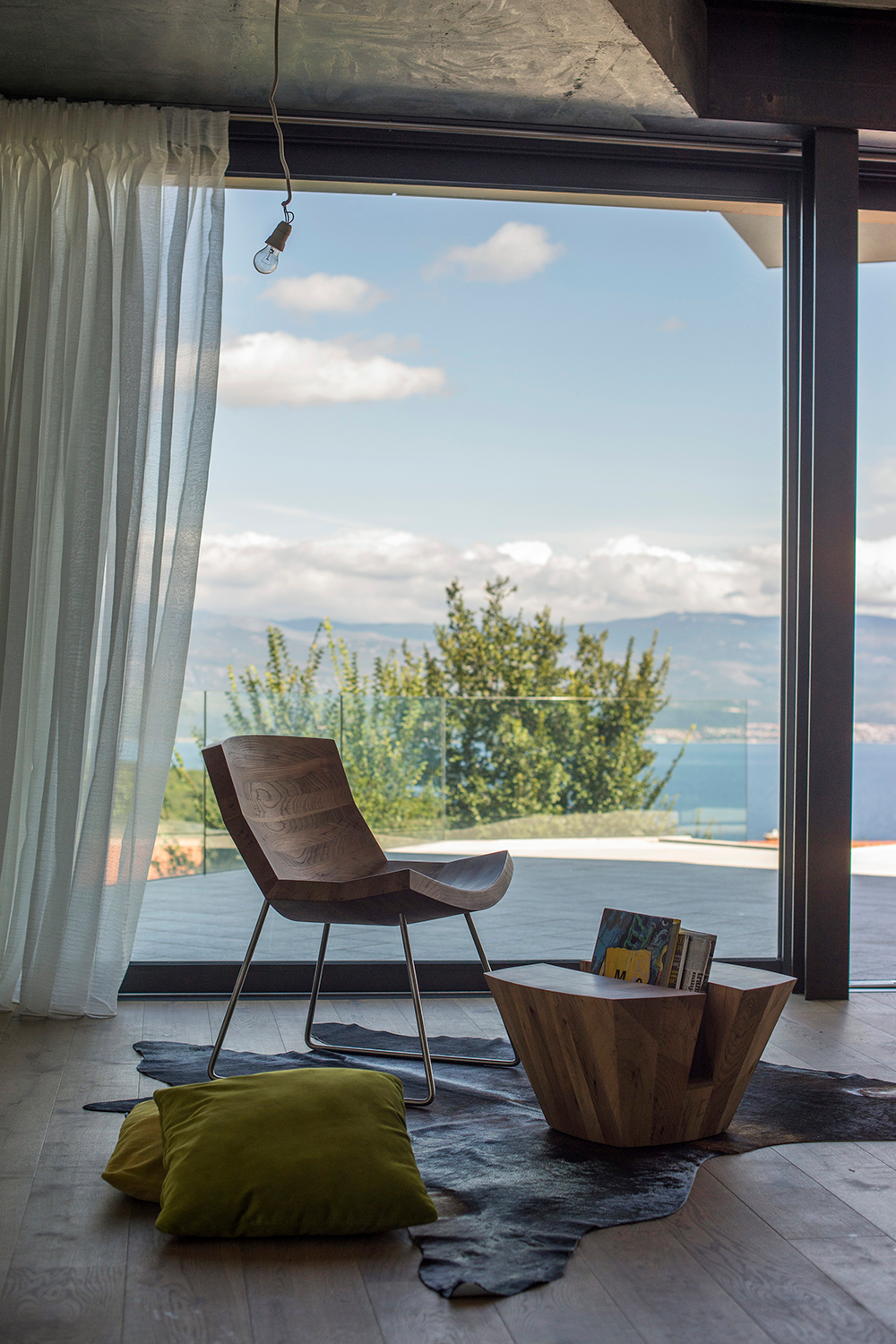
Not against the wall. An armchair is the piece of furniture with the greatest freedom – slightly angled towards the seating group, turned into a corner, placed in front of a window.
What it needs is a surface within reach and light from behind or from the side. An armchair without both will not be used, however comfortable it is.
It needs space even when it looks small. In front of the seat, around 60–80 cm (23.6–31.5 in) should remain free, so that you can get in comfortably and stretch your legs. Models that swivel or rock also need room behind and to the side; their actual space requirement is greater than the footprint suggests. If you are unsure, tape the dimensions onto the floor with masking tape before buying – that shows faster than any drawing whether the path past it remains clear.
Two armchairs or one
Two identical armchairs opposite a sofa look formal and work well in larger rooms. A single armchair looks more casual and suits small rooms better.
Two different armchairs work if seat height and colour family match. What never works is two armchairs with clearly different seat heights in the same field of view.
It helps to pick one shared feature and leave the rest open: the same wood with different covers, the same cover with different forms. If you want to match everything, you end up with a set; if you match nothing, with a random mix.
Frequently asked questions
What seat height should an armchair have?
44–48 cm (17.3–18.9 in) for upright sitting. Lounge chairs sit lower and are built for relaxed leaning back.
How can you recognise a long-lasting armchair?
By its suspension. Steel springs or rubber webbing beneath the upholstery prevent the seat from sagging over the years.
Leather or fabric?
Leather is more resistant to stains and ages beautifully, but reacts to sun. Fabric is warmer and more pleasant on the skin; how well it tolerates daily use depends on the weave. Faux leather is easy to care for but does not develop a patina.
How much space does an armchair need?
Around 60–80 cm (23.6–31.5 in) of free space in front of the seat. Swivelling or rocking models also need room behind and to the side.
Do two armchairs have to be identical?
No, but seat height and colour family should match. Different seat heights next to each other are immediately noticeable.


