

Furnishing the hallway and entrance
The hallway is the first room you enter, and usually the only one that was never planned. Yet it sets the first impression of a home – and whether everyday life works in it.
Depth is the decisive measurement
A walkway needs 80–90 cm (31.5–35.4 in) of clear width. Whatever is available beyond that may be taken up by a piece of furniture – no more.
In a hallway 120 cm (47.2 in) wide, that leaves around 30–40 cm (11.8–15.7 in) of depth. That rules out normal chests of drawers and leads to narrow consoles, shallow sideboards or wall units. This calculation belongs before every purchase, not after it.
What needs measuring is not only the wall but also the area that open doors require. When opening, a door leaf sweeps a quarter circle with the radius of its own width – with standard interior doors that is about 60–90 cm (23.6–35.4 in). This area stays clear, otherwise the door hits the furniture or can only be half opened. The same applies to the front door, which usually opens inwards and claims exactly the area in which jackets are put down and shoes taken off at the same time.
A surface at hand height
Keys, post, glasses, headphones – these things end up somewhere. If there is no designated place, it becomes the first free surface beyond, usually in the kitchen.
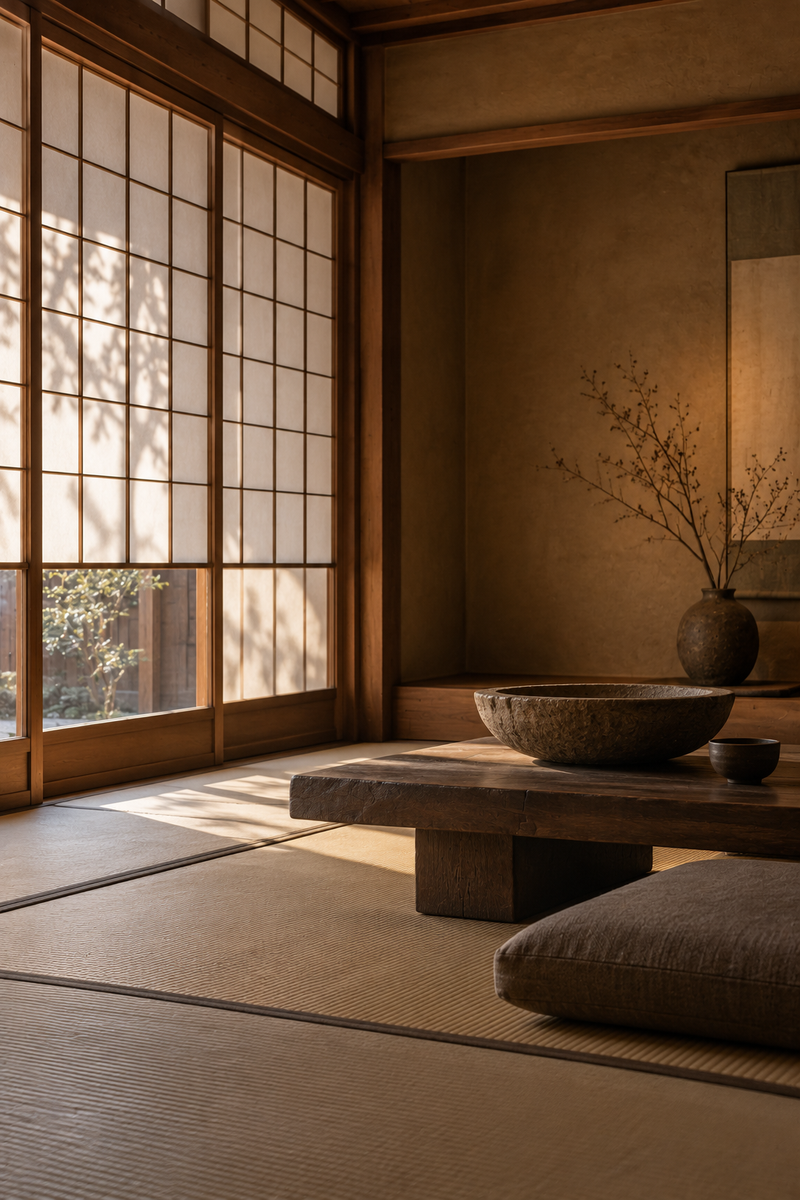
A shallow console or a wall shelf at a height of about 80–90 cm (31.5–35.4 in) solves this. That height roughly corresponds to that of a kitchen worktop: the surface can be reached in passing without having to bend down. Exactly one vessel belongs on it – a bowl for small items – and nothing else.
With stone bowls it is worth looking at the hardness. The Mohs scale ranks minerals from 1 to 10, and metal keys or coins are at about 4 to 5. Anything below that gets marked immediately. Selenite, a variety of gypsum, reaches only Mohs hardness 2 and can be scratched even with a fingernail – which makes it unsuitable for keys. Marble is at about 3 and is likewise sensitive. Agate and other quartz varieties reach 6.5 to 7, and granite falls within a similar range. Such materials take daily use without complaint.
One ceiling light is not enough
Hallways rarely have daylight and usually a single ceiling light. That creates hard shadows and makes the corridor feel like a tunnel.
Two points of light at different heights are better – for instance a wall light and a small table lamp on the console. Warm white, because a hallway is the transition from outside to inside and artificial light is noticed there immediately. Light colours below about 3,300 kelvin count as warm white; around 2,700 kelvin is common, which comes close to the light of the classic incandescent bulb.
If there is no second electrical point, a plug-in or battery-powered light helps – the effect comes from light at a second height, not from the wiring. A mirror next to or opposite a light source strengthens its effect, because it reflects the light back into the room. Directly opposite the front door, however, it is badly placed: on entering you immediately look at your own reflection, and the focal point sits where you need it least.
To go with this article


Where the shoes belong
Shoes are the real reason why entrances look restless. Usually they lie at angles, in varying numbers, in every colour.
What helps is closed storage instead of an open rack – even if it holds less. A hallway with four neatly stored pairs looks tidier than one with twelve on view.
Cabinets with flaps, in which the shoes stand at an angle, suit narrow hallways. Such furniture manages with around 20–30 cm (7.9–11.8 in) of depth and fits where a conventional cabinet would block the walkway. If you own many pairs, it is best to sort by frequency: what is worn daily stays in the entrance area, the rest moves to another room. Wet shoes need time to dry before being shut away, otherwise the moisture stays trapped in the closed furniture.
A single focal point
A narrow room can take exactly one thing that gets attention: a large picture, a mirror, a striking light. Several small objects at different heights make the corridor restless.
Where this point belongs depends on what the hallway is meant to do. Both options work; they simply pursue different aims. An object at the end of a long hallway catches the eye and stops it there: the corridor looks shorter, more enclosed and more like a room than a passage. If the end is left free, on the other hand, the eye carries on, and the hallway gains visual depth.
This gives a simple rule. If a long hallway feels like a tunnel and is meant to appear shorter, the focal point belongs at the end. If the hallway is short or squat and is meant to look deeper, the end stays free and the focal point moves to a side wall. Choose one – doing both at once cancels the effect out.
Frequently asked questions
How deep can furniture in the hallway be?
Deep enough that 80–90 cm (31.5–35.4 in) of walkway stays clear. In a hallway 120 cm (47.2 in) wide, that is about 30–40 cm (11.8–15.7 in). In addition, the area over which open doors swing stays clear.
What belongs in an entrance area?
A surface at hand height, closed shoe storage, two points of light at different heights and a single eye-catcher.
Does the focal point belong at the end of the hallway?
Only if the corridor is long and is meant to look shorter, because there the object catches the eye. If a short hallway is to gain more depth, the end stays free and the focal point hangs on a side wall.
What lighting suits the hallway?
Two warm white light sources at different heights instead of a single ceiling light. Warm white means a light colour below about 3,300 kelvin.
Which material is suitable for a key tray?
A hard one. Agate and other quartz varieties are at Mohs hardness 6.5 to 7 and stand up to keys and coins. Soft stones such as selenite with Mohs hardness 2 get scratched immediately.
View all furniture in the shop
View all bowls in the shop
View all lights in the shop


