Natural stone: why limestone does not tolerate acid
Natural stone is usually bought for its looks and regretted for its looks. Yet almost everything that happens in everyday use is decided by a single property: whether the stone contains lime or not.
Calcareous stones are soft and sensitive to acid, silicate stones are hard and acid-resistant. In practice there is more difference between the two groups than between two furniture materials – and in the home, of all things, the most beautiful stones belong to the sensitive group.
Two groups, one difference
The first group includes marble, limestone, travertine and onyx marble. They consist predominantly of calcium carbonate. The second includes granite, quartzite, slate and sandstone, which are made up predominantly of quartz, feldspar and mica.
The difference in hardness is large. Marble has a Mohs hardness of 3 and so counts among the soft stones – it can be scratched with a coin. Granite and quartzite are at 6 to 7, that is, in the range where only steel and harder minerals leave marks.
A classification that often gets muddled: marble is metamorphosed limestone, but not every limestone is marble. Both consist predominantly of the same substance and differ in formation and structure. Limestone is usually light and matt, marble crystalline and glittering, and travertine a limestone with the typical open pore structure.
Acid is the real enemy
With calcareous stones, the main problem is not scratching but chemistry. Even weak acids such as vinegar or lemon juice attack calcium carbonate and leave matt patches and loss of shine.
This happens quickly and quietly. A splash of lemon on a polished marble surface needs less than an hour to create a visibly dull spot. And it is not a deposit that could be wiped off – the surface itself has been etched.
The list of everyday substances that contain acid is longer than one might think: lemon and vinegar, wine, cola, fruit juice, tomato sauce, many descalers and most bathroom cleaners. None of it belongs on limestone, not even briefly.
With silicate stones this does not matter. Granite and quartzite are acid-resistant and considerably more scratch-resistant – which is why they are found on worktops and limestone tends not to be.
What sealing does and does not do
Most natural stones benefit from an impregnating sealer. It soaks into the pores and repels liquids, so that they stay on the surface instead of soaking in. In this way it prevents stains, that is, anything that discolours: oil, wine, coffee.
What it cannot do is the important part. A sealer is no protection against acid. It sits in the pores, not as a closed film on top, and an acid attack still takes place at the stone surface. A sealed marble is protected against red wine and not against lemon juice.
And it does not last for ever. How long depends on use, cleaning and product – there is no universally valid figure. You can tell it has worn off when water no longer beads but soaks into the stone and the spot becomes darker. That is the moment when it should be renewed.
To go with this article
Pores are a design question
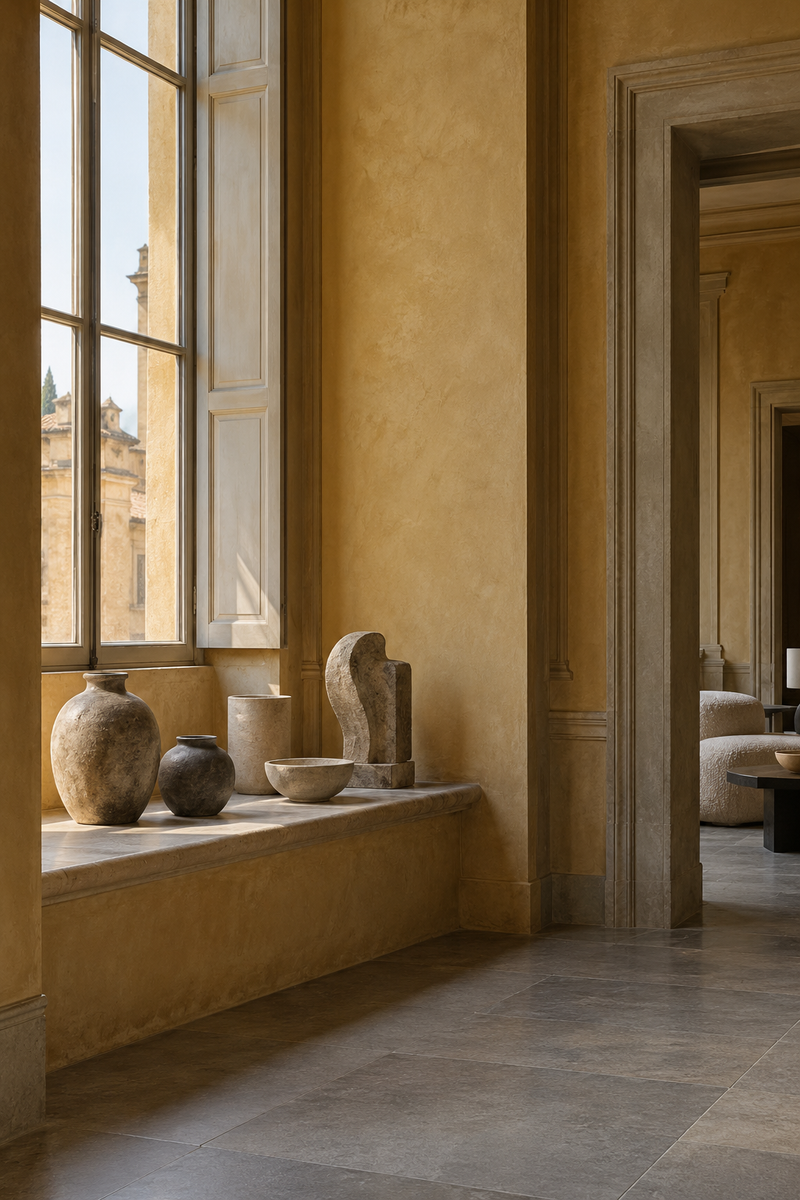
With porous stones there are two finishes, and the difference is not only about looks.
Unfilled, the stone stays as it comes from the quarry – the pores are visible and can be felt, the surface looks lively and less severe. But it also catches dust, and liquid has a way in.
Filled means that the pores have been closed with a compound. The surface becomes smoother, easier to care for and calmer, but loses precisely the texture for which the stone was chosen.
Both are right; it depends on the place. On a surface where things are put down, filled is more practical. For an object that stands on its own, unfilled is usually the more beautiful.
Every piece is a section
What distinguishes natural stone from every manufactured material: the pattern is not designed but found. Veins, pores, colour changes and inclusions come from the formation of the rock, and nobody chose them.
That means two things. First, that no piece corresponds exactly to the sample photo, and two objects from the same series can look clearly different. Second, that a vein does not have to be a weak point but can be one – a stone is more likely to break along pronounced layering than in a homogeneous area.
Anyone who buys natural stone is therefore choosing a principle, not a look. Anyone who wants an exactly predictable pattern is better off with a manufactured material – and should then choose that, instead of being annoyed about the stone that is delivered.
Care: less is more
For calcareous stones: pH-neutral cleaner or clear water, a soft cloth, then wipe dry. No vinegar cleaners, no descalers, no cream cleanser. Wipe up spills immediately, because the length of exposure determines the damage.
On limestone, coasters are not a café ritual but the only effective precaution. A glass of wine does not need a puddle to leave a ring mark.
With silicate stones, care is considerably more relaxed. Abrasives do harm there too, but acid is not an issue.
And for both: natural stone is heavy. A piece standing on a shelf that is not built for it will at some point bring down the shelf, not the stone.
Frequently asked questions
Why does marble get matt patches?
Because it consists predominantly of calcium carbonate, and even weak acids such as vinegar or lemon juice dissolve it. The spot is not a deposit but an attacked surface, and cannot be wiped off.
How hard is marble compared with granite?
Marble has a Mohs hardness of 3 and counts among the soft stones, granite and quartzite 6 to 7. Granite is therefore considerably more scratch-resistant and also acid-resistant.
Does a sealer protect against everything?
No. It prevents liquids from soaking in and leaving stains, but it is no protection against acid. A sealed marble is protected against red wine and not against lemon juice.
Is travertine the same as marble?
No, but related. Both are calcareous and sensitive to acid. Travertine is a limestone with a typical open pore structure, marble crystalline.
Why does my piece look different from the photo?
Because veins, pores and colour changes come from the formation of the rock and are not designed. Every piece is a section of a block and cannot be repeated.
View all decoration in the shop
View all bowls in the shop
View all tables in the shop