

Lighting the Living Space: Kelvin, Lumens and Three Levels
Light is the only furnishing decision that changes twice a day. Until the afternoon the window does the work, after that a handful of lights. Anyone who plans everything else and leaves the lighting to the electrician at the end ends up with a room that, from six in the evening, looks different from what was intended.
Kelvin: the number that decides the mood
The colour of the light is stated in kelvin on the packaging of every bulb. Low values mean warm, yellowish light, high values cool and white light.
2700 kelvin is the value for living spaces. It is close to the old incandescent bulb, lets oak and walnut appear brown instead of grey and is kind to skin. 3000 kelvin appears a touch clearer and suits the kitchen counter or the bathroom. From around 3300 kelvin neutral white begins, from 4000 kelvin it is clearly visible: matter-of-fact, high in contrast, right above a worktop, wrong above a sofa.
The more common mistake, however, is not the wrong choice but the mixed one. Four lights in a room with 2700, 3000 and 4000 kelvin make a room look restless without anyone being able to say why. This is exactly what happens when individual bulbs are bought as replacements, because the kelvin value is printed small on the back of the pack. One colour temperature per room. Two only if a workspace is clearly separated.
Lumens instead of watts
Watts describe consumption, lumens the amount of light. As long as there were incandescent bulbs, that was practically the same thing. With LED it no longer is.
The conversion: 470 lumens correspond roughly to the old 40-watt bulb, 806 lumens to the 60-watt bulb, 1521 lumens to the 100-watt bulb. An LED delivers roughly 80 to 100 lumens per watt. A 6-watt LED bulb is therefore roughly on a par with the old 40-watt bulb: mood lighting, not the general brightness of a room. Conversely, an LED with around 15 watts sits where the 100-watt bulb used to be.
For a living room, around 100 lumens per square metre is often used as a basis, distributed across all lights together. A room of 25 square metres (269 sq ft) would thus come to about 2,500 lumens. The value is a starting point, not a law: dark walls and heavy curtains swallow a considerable part of it, pale ceilings and mirrors reflect it back. More important than the total, in any case, is how it is distributed in the room.
A second value is worth a look as soon as a shade is involved. The lumen figure applies to the bare bulb, not to the finished light. A dense fabric shade or a narrow metal cylinder holds back part of the light and directs the rest upwards and downwards. In practice this means: with heavily shielded lights, it does no harm to choose a bulb one step brighter than the calculation suggests.
Three levels instead of one ceiling light
A single light on the ceiling illuminates a room evenly and makes it flat in the process. Everything gets the same amount of light, nothing stands out, the shadows fall vertically downwards and settle unflatteringly under eyes and nose. That is the reason why rooms with only one ceiling lamp feel inhospitable in the evening, regardless of how well they are furnished.
Three heights work better.
At the top, at 2.40 to 2.60 metres (7.9–8.5 ft), is the general light. It should make the room usable, nothing more. As soon as the other levels are lit, it may be dimmed or switched off entirely.
At table height, that is between 70 and 130 centimetres (27.6–51.2 in) above the floor, is the light you actually sit by. A table lamp on the sideboard, a second on the side table next to the armchair. A table lamp of around 50 centimetres (19.7 in) in height on a 75-centimetre (29.5 in) sideboard gives a light source at 1.25 metres (4.1 ft), a 30-centimetre (11.8 in) model comes to 1.05 metres (3.4 ft). In both cases the light falls sideways into the room instead of onto it from above. That the top edge may then lie at eye level when seated is not a problem, as long as a shade covers the bulb.
In the lower third, below 40 centimetres (15.7 in), floor lights, candles and everything that shines against a wall from below do their work. This level is the one most often forgotten and the one that makes a room soft in the evening. It delivers hardly any measurable brightness, yet does more than anything else to change the feel of a room.
Three light sources at three heights beat five light sources at one height. That holds even if the five together give off more lumens.
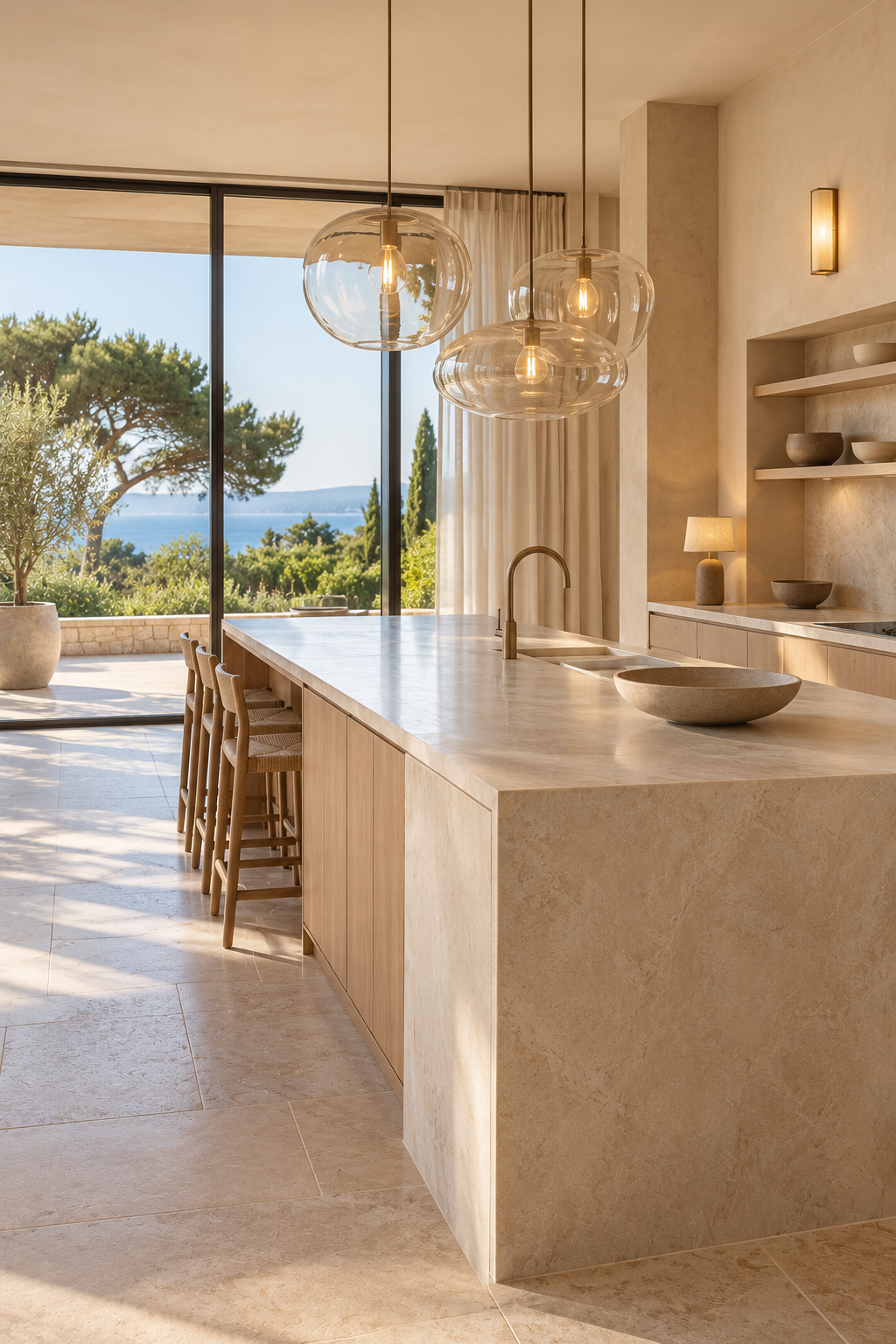
Glare and the zone between 1.15 and 1.75 metres (3.8–5.7 ft)
A visible bulb at eye level ruins any lighting plan. When seated, the eyes are about 1.15 to 1.25 metres (3.8–4.1 ft) above the floor, when standing 1.55 to 1.75 (5.1–5.7 ft). Nothing that shines unfiltered should hang in this band.
This mainly concerns shades open at the bottom, glass globes with a visible filament and wall lights at head height. A textile shade solves the problem: fabrics of linen, cotton or wool let the light out diffused, while the point of light itself stays covered. The density of the fabric makes the difference here. Light, thin fabrics give off a lot of light sideways into the room and become a glowing surface themselves; dense or dark fabrics direct almost everything upwards and downwards and so create an accent rather than general light. Opal glass and satin-finished glass serve the same purpose, whereas clear glass shows the bulb openly.
This is where things get uncomfortable: many lights that look good in product photos are unusable for exactly this reason. An exposed bulb photographs excellently and causes glare in everyday life from the first evening. Anyone who wants such a light anyway places it outside the glare zone: low above a tabletop, high above standing height or with the bulb turned upwards.
Dimming is not an extra, but a foundation
A living room is used differently at ten in the morning than at ten in the evening. Without a dimmer, there is only on or off.
There are two pitfalls. Firstly, the bulb must be dimmable, which is not a given with LED and is indicated on the pack. Secondly, the dimmer must suit the LED, otherwise it flickers or hums. Conventional dimmers from the incandescent era are designed for considerably higher loads and often cannot cope with a few watts of LED.
Anyone who cannot or does not want to replace the wall switch turns to lights with their own control. A rotary dimmer on the base, a cord dimmer in the cable or a plug-in adapter with a dimming function each control only the one light and need no changes to the wiring. In rented flats this is often the only practicable way. And even entirely without a dimmer, a lot can be achieved: several small light sources on separate switches produce graded levels of brightness, because the number of lights switched on can be controlled instead of their brightness.
Incidentally: dimmed LED usually only becomes darker, not warmer. The old incandescent bulb slid towards 2200 kelvin when dimmed down and so automatically became cosier in the evening. Anyone who wants this effect needs bulbs labelled dim-to-warm.
CRI: why colours look dead under some light
The colour rendering index, CRI or Ra for short, describes how natural colours appear under a light source. Daylight has the reference value of 100.
Cheap LED is often at Ra 80. That is enough in the cellar and is immediately noticeable in a living space: cognac-coloured leather becomes brownish and dull, a wool rug loses its nuances of colour, reds and skin tones look off. Ra 90 and above is the range in which materials once again look as they did in the shop. The difference costs a few euros per bulb and is the most underestimated point of the entire lighting plan.
The value is not on every pack. Where it is missing, it is rarely high. It matters above all where materials are meant to show at their best: above the dining table, next to the sofa, on the wall with pictures. In purely functional places such as a storeroom or cellar it plays no role.
Frequently asked questions
Which colour temperature suits a living room?
2700 kelvin. That corresponds to the old incandescent bulb and lets wood, leather and skin appear warm. 3000 kelvin works at the kitchen counter and washstand. Everything from 4000 kelvin belongs at work surfaces.
How many lumens does a room need?
As a starting point, allow about 100 lumens per square metre across all lights together, so around 2,500 lumens for 25 square metres (269 sq ft). Dark walls and heavy curtains swallow a considerable part of that. More important than the total is how the light is distributed in the room.
Why does a ceiling light on its own feel so uninviting?
Because it makes everything equally bright and shines vertically downwards. No contrasts arise, but hard shadows on faces do. Only light at table height and in the lower third brings depth into the room.
At what height does a light cause glare?
Between about 1.15 and 1.75 metres (3.8–5.7 ft) above the floor, because that is where the eyes are when seated and standing. In this range no bulb should be visible uncovered. A shade of fabric or opal glass defuses the zone.
What does CRI mean for a bulb?
CRI or Ra indicates colour rendering; daylight corresponds to 100. Ra 80 makes materials look dull; from Ra 90, leather, wood and textiles once again look as they did in the shop.


