Ceramics, earthenware, porcelain: the difference in everyday use
Ceramics is the umbrella term. Earthenware, stoneware and porcelain are subgroups of it – distinguished not by appearance but by firing temperature. And that determines almost everything that matters in everyday use.
Earthenware: low-fired, porous
Earthenware is fired at about 1,000 to 1,150 °C. The body – as the fired clay is called – remains porous and absorbs water.
That is why earthenware has to be fully glazed. If the glaze has chipped off at one spot, moisture soaks in there, and the piece can be damaged by frost or in the dishwasher.
The advantage: earthenware is lighter, can be shaped more freely and looks softer. For decorative objects and bowls that do not end up in the dishwasher every day, it is the choice with more character.
Stoneware: densely sintered
At 1,200 to 1,300 °C, the body fuses to the point where it absorbs almost no water. This is called sintering, and it is the decisive step.
Stoneware is therefore dishwasher-safe, frost-resistant and considerably less sensitive to knocks. Even if the glaze gets scratched, it does no harm, because the body beneath is itself dense. For tableware used every day, this is the sensible choice.
Porcelain: the finest
Porcelain is fired at 1,300 to 1,450 °C and consists of kaolin, feldspar and quartz. It is white, very dense and translucent where thin – anyone who holds a cup up to the light and sees the shadow of their fingers showing through is holding porcelain. Then there is the sound: tapped lightly, porcelain gives a bright, long-resonating note, earthenware with a dull, short one.
It is harder than the other two and allows thinner walls. The drawback is brittleness: ceramics do not give under a knock, they break. Where stoneware can still take a knock, porcelain is more likely to lose a chip from the edge. If you are looking for porcelain, it should therefore be named explicitly – and that is often exactly where descriptions fall short.
Why "ceramic" so often stands alone
Many product descriptions say only "ceramic", without a more precise classification. That is not wrong, but it says little, because the term covers everything from a flowerpot to a porcelain plate. In the trade, "ceramic" is also often used in the sense of stoneware, while the same term on another label can mean a low-fired earthenware.
Making matters harder, the subgroups can hardly be told apart with the naked eye once an opaque glaze has been applied. A white, smoothly glazed mug can be stoneware or porcelain – the surface does not reveal it. The best clue is the unglazed foot ring on the underside, because it shows the body in its raw state: chalky and slightly rough with earthenware, hard and fine-grained with stoneware, very white and glass-like with porcelain.
To find out more precisely what you are dealing with, look at the usage information. Dishwasher-safe, microwave-safe or frost-resistant indicate indirectly how hot the piece was fired. Frost resistance can only be promised with a densely sintered body, that is, with stoneware or porcelain. A note on water-tightness, on the other hand, often refers to the glaze and says little about the body beneath. And where only hand washing is explicitly recommended, a porous or delicately decorated piece is more likely.
Handmade means uneven
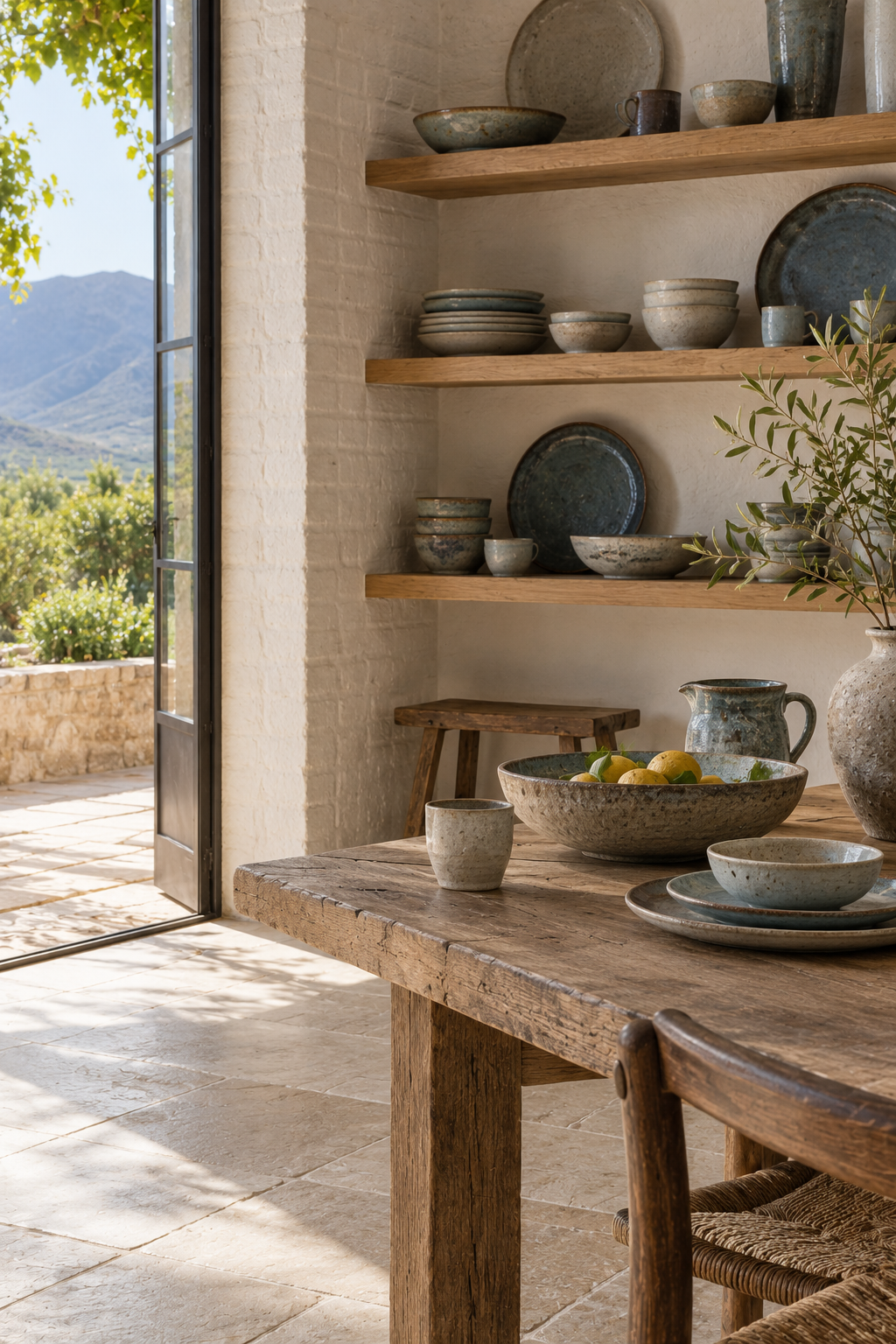
With handmade ceramics, dimensions, glaze flow and colour differ from piece to piece. Small pinholes in the glaze, a slightly wavy rim or colour differences between two plates of the same set are features of the process.
The speckled surface often seen on handmade ware also has a technical reason: iron-bearing particles in the clay come through the glaze during firing and appear as fine dark dots. Colour nuances arise in the kiln, because temperature and airflow are not the same everywhere, and more glaze collects at thicker spots, which makes the colour look deeper there. Two pieces from the same firing can therefore differ without either of them being faulty.
Anyone who wants exact uniformity is better served by industrially made porcelain.
Glaze and decoration
The glaze is a thin layer of glass that melts onto the body during firing. It makes the surface smooth and washable, and with a porous body it is the precondition for a piece being suitable for food at all. It does not offer indestructible protection: it can crack, chip and become dull over the years.
With decoration, what matters is whether it sits under or over the glaze. Underglaze decoration is applied before the glaze firing and is then enclosed by the molten glaze; it practically cannot be rubbed off. Overglaze decoration lies on top and is fired on only at a comparatively low temperature. This allows stronger colours as well as gold and platinum rims, but makes the decoration vulnerable to cutlery marks, harsh cleaners and the dishwasher. Metallic rims should also never go in the microwave.
What really damages tableware
Not the dishwasher as such, but the combination of heat and aggressive detergent. Over the years, this combination attacks the glaze, especially with decorations that do not lie under the glaze.
The second common cause of damage is thermal shock: a hot bowl under cold water. Body and glaze expand to different degrees, and the more porous the body, the more likely fine cracks are to form in the glaze. Once they are there, they draw in liquid and colour and show up as a brownish network.
Long life therefore takes little effort, but regular care: do not stack pieces tightly inside one another, let hot tableware cool down instead of quenching it, and favour hand washing for decorated or unglazed pieces.
Frequently asked questions
What is the difference between ceramics and porcelain?
Ceramics is the umbrella term. Porcelain is a ceramic fired at a very high temperature from kaolin, feldspar and quartz – white, dense and translucent when thin-walled.
Is earthenware dishwasher-safe?
Only to a limited extent. The body is porous and depends on an intact glaze. If the glaze is damaged, water soaks in.
How can you recognise porcelain?
By its translucency where thin and by the bright, long-resonating note when tapped lightly.
What is stoneware?
Ceramic fired at 1,200 to 1,300 °C with a densely sintered body. Dishwasher-safe, frost-resistant and robust in everyday use.
Why do two handmade plates look different?
Because glaze application and position in the kiln vary. Colour differences and small irregularities are part of the process.