Materials You Can See and Feel
A room looks expensive or cheap long before anyone knows a price. The difference rarely lies in the form. It comes from how surfaces treat light: whether they reflect it, absorb it or scatter it.
That is why material is not a question of taste but a decision with consequences – for the look, but also for care. What each of the major materials can do and where it reaches its limits is set out here.
Wood
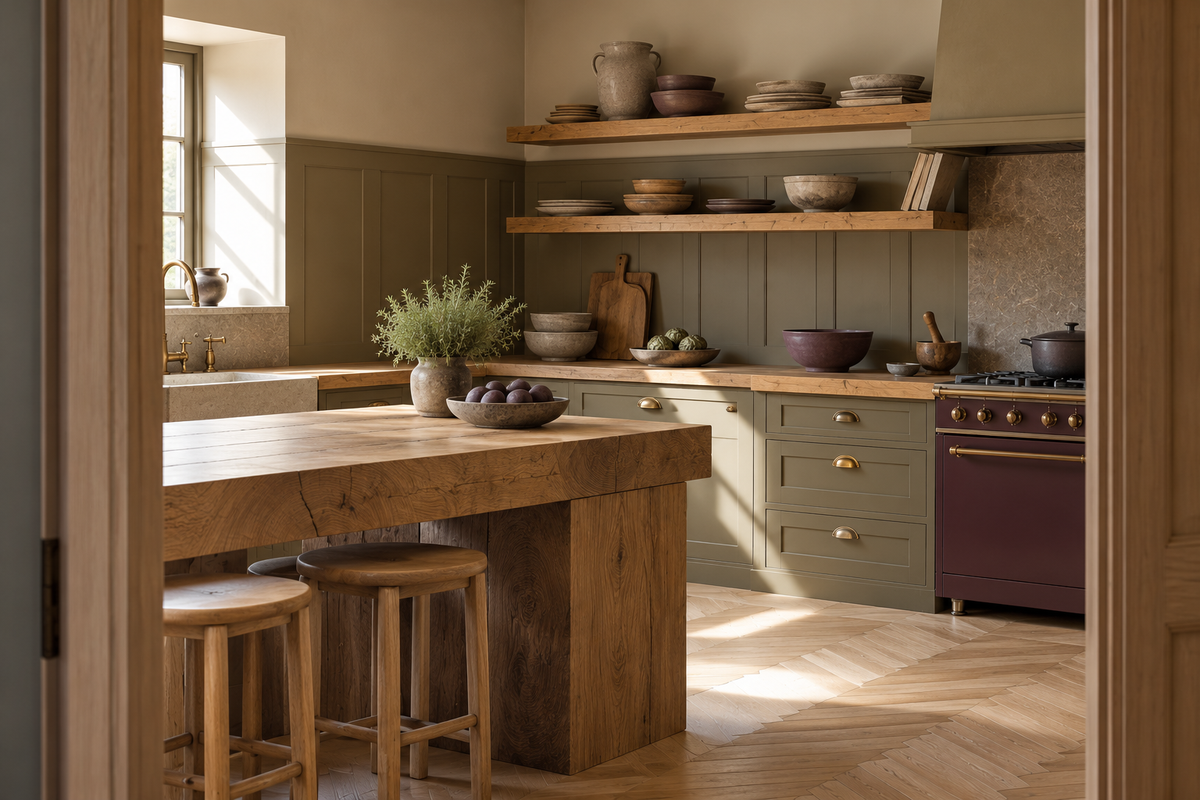
Solid wood moves. It absorbs moisture from the air and releases it again, which is why its dimensions change by millimetres over the year. This is not a defect but the reason why well-built wooden furniture has joints that accommodate this movement.
The relationship can be put into figures. In heated interiors, the moisture content of wood fluctuates roughly between 6 and 12 per cent depending on the season – lower in winter, because warm air from heating is dry, higher in summer. One percentage point of change in moisture means a dimensional change of around 0.2 to 0.3 per cent across the grain. With a panel 80 cm (31.5 in) wide, this adds up to several millimetres over the year. Along the grain, by contrast, wood hardly moves at all, and tangentially about twice as much as radially. It is precisely this difference that causes cupping and cracks when a construction does not allow for the movement.
In light, oiled wood behaves differently from lacquered wood. The oil penetrates the upper layers of the wood and gives the grain depth; lacquer lays a film over it that slightly flattens the grain but protects better against liquids. The difference also shows with damage: a spot in an oiled surface can be touched up locally, a scratch in lacquer usually only by refinishing the whole surface.
If you are looking for the difference between oak, ash and walnut, you will find it less in the colour than in the figure and density. Oak and ash come in at about 700 kilograms per cubic metre (43.7 lb per cubic foot), walnut just below. Denser woods are more resistant to dents, but show fine scratches more clearly because their surface stays smoother. And all three change their tone under light: walnut becomes lighter over the years, oak more golden brown.
Natural stone
Stone is heavier than most people expect. The common types weigh between about 2.4 and 2.8 tonnes per cubic metre (149.8 and 174.8 lb per cubic foot), travertine and limestone at the lower end, granite at the upper. In practice this means: a hand-sized object of solid stone quickly weighs 4–5 kg (8.82–11.02 lb), even though it looks light in a photo. This helps decide which shelf and which wall fixing are possible at all – and whether a thin glass top is still suitable as a surface to stand it on.
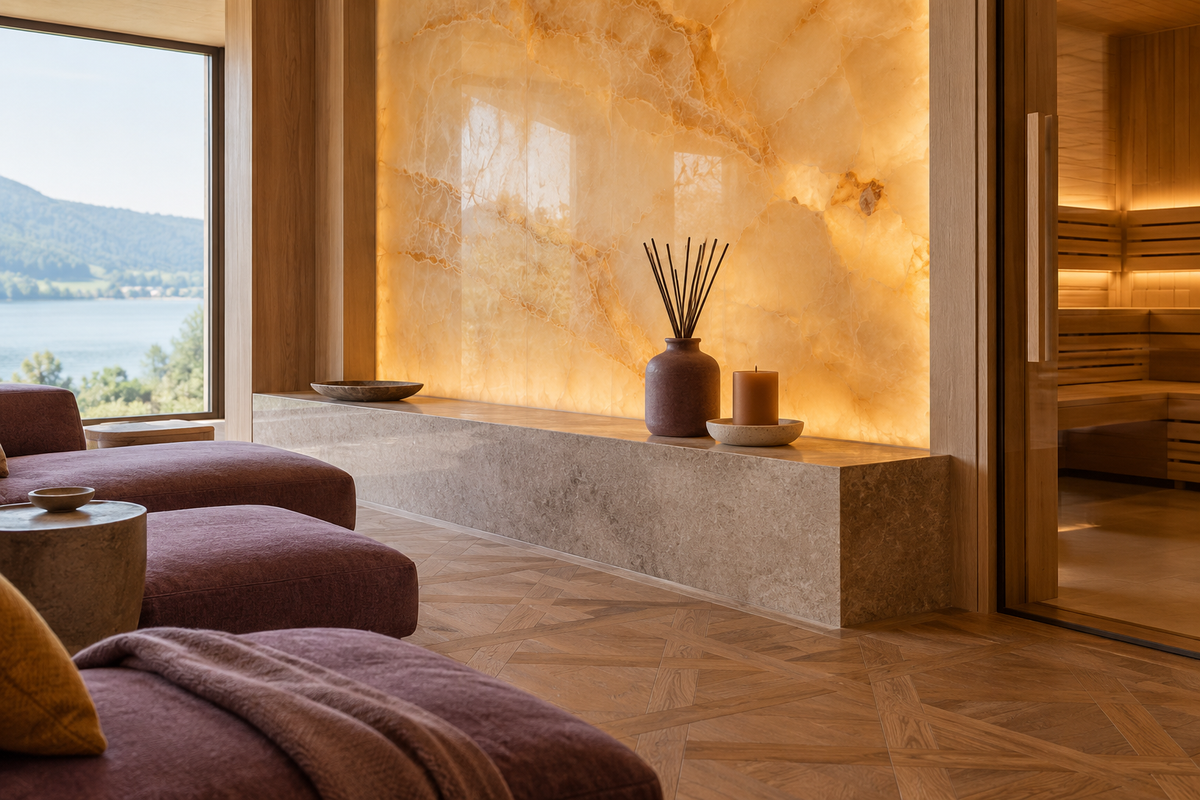
The visual advantage lies in the porosity. A matt, open-pored surface scatters light instead of mirroring it, and so makes a room feel warmer than polished marble. Travertine owes its holes to the way it forms: it develops at calcareous springs when carbon dioxide escapes from the water and lime precipitates; in the process it encloses cavities. These pores can be filled or left open – open looks livelier, filled is easier to care for.
The downside: limestone is sensitive to acid. Lemon, vinegar or red wine attack the surface and leave matt marks that stay. This is not a stain in the true sense but an etched structure – which is why cleaning does nothing against it. An impregnating sealer delays the penetration of liquid but does not remove the sensitivity to acid. If you use stone near the kitchen or dining table, you should plan for this from the outset.
Ceramics
Here a single figure decides almost everything: the firing temperature. Earthenware is fired at around 1,000 to 1,150 °C and remains porous, stoneware at 1,200 to 1,300 °C and is densely sintered, porcelain at up to 1,450 °C and becomes translucent where thin-walled.
Behind this is a physical process. Above a certain temperature the body begins to sinter: the pores close, the material shrinks and becomes dense. Earthenware never quite reaches this point and still absorbs several per cent of water; stoneware usually stays below three per cent, porcelain practically at zero. Everything else follows from this one property: a porous body is only as watertight as its glaze. If the glaze develops hairline cracks, water seeps underneath and rims darken over the years.
In practice this means: earthenware is the more characterful choice for objects, stoneware the more sensible one for tableware that goes into the dishwasher every day. If a description says only “ceramic”, the information on use – dishwasher-safe, microwave-safe or purely decorative – says more about the material than the word itself.
A second point concerns appearance. Glazes build up visibly and thin out at edges, which is why the colour of the body often shows through there. Unglazed or only partly glazed surfaces feel rough and absorb grease from hands; over time they become blotchy, which may be intentional for objects but rarely is for tableware.
Glass
Glass is the only material in the room that does not just reflect light but lets it through and colours it in the process. A coloured glass object casts a colour onto the surface it stands on – larger and softer than the object itself. How strong this colour is depends on the wall thickness: the same tint looks richer in thick glass, because the light travels a longer path through the material.
Technically there is a difference that matters in everyday life. Borosilicate glass expands considerably less with heat than ordinary soda-lime glass: around 3.3 millionths per degree compared with about 9, so a good third of the value. Because stresses in glass arise from uneven expansion, borosilicate glass therefore copes better with sudden changes in temperature – as a rule of thumb a difference of about 150 °C instead of around 40 °C. Where a candle burns directly against the glass or hot water is poured in, this is not a marketing detail.
Two further distinctions help in telling glass apart. Mouth-blown glass shows small air bubbles and slightly uneven wall thicknesses; these are traces of manufacture, not faults, and they refract light visibly more unevenly than machine-made glass. And there are two ways of colouring: coloured right through the mass, or cased, where a thin coloured layer lies on clear glass. A ground edge shows which way was chosen.

Metal
In a room, metal above all creates lines. A slender frame carries a heavy top without adding visual weight – which is why furniture with a metal frame looks lighter than furniture with wooden side panels, at the same weight.
Metal also feels cold, even when it is at room temperature. The reason is thermal conductivity: steel conducts heat several hundred times better than wood, aluminium and copper several times more again. The hand therefore gives off its warmth quickly and reports “cold”, even though both materials are equally warm. This is an argument for mixing materials: a room in which almost everything is metal and stone does not only look cool.
Unlacquered brass darkens over time. It is an alloy of copper and zinc; in air, it is mainly the copper that reacts with oxygen and moisture to form a thin layer that is golden brown at first and later brownish. This patina sits only on the surface and protects the metal beneath. Hand perspiration speeds up the process, which is why handles and grip areas darken first. If you do not want this, you need a lacquered surface; if you do, leave the polish alone, because every time you polish, the patina comes off again.
For the other metals, roughly: stainless steel forms an invisible passive layer of chromium oxide and therefore stays bright. Powder-coated steel is as durable as its coating – once that is worn through, it rusts at that spot. Raw steel rusts as soon as it gets damp, and the rust flakes off instead of protecting. Aluminium oxidises too, but its oxide layer is colourless, firm and stops the process by itself.
Textiles
Textiles are the counterweight to everything else. Stone, glass and metal reflect sound; a wool rug absorbs it. A room with many hard surfaces sounds echoey, and this is often noticed before it is named.
This too can be put in context. Hard, smooth surfaces absorb only a few per cent of the sound that hits them; a dense rug or a heavy curtain, by contrast, absorbs half to two thirds at high and medium frequencies. What matters is mass and air: a curtain that hangs in folds and stands off the wall is considerably more effective than the same fabric stretched flat. Low tones can hardly be tamed with textiles alone; the fabric thicknesses are too small for that.
The fibres differ more than their appearance suggests. Wool absorbs moisture, up to about a third of its own weight, without feeling wet. It smells more noticeably in high humidity, but is naturally flame-retardant and slightly dirt-repellent. Linen creases visibly, becomes softer with every wash and conducts heat away well, which is why it feels cool. Cotton lies in between and is the most straightforward to care for. Synthetic fibres are more abrasion-resistant and colourfast, but are more prone to static and feel smoother.
How many materials a room can take
Three to four, with one of them dominant. More quickly looks like a showroom; fewer looks flat.
The most common mistake is not too much material but too little contrast in sheen. Gloss is measured in gloss units: matt surfaces lie below about 10, satin in the middle range, high-gloss above 80. If everything stays in the matt range, a room looks dull. A single glossy element – glass, polished metal, a glaze – is enough for the matt surfaces to become visible at all.
The second lever is touch. Materials that look similar but feel different – oiled oak next to matt stone, linen next to wool – keep a room calm yet lively. And because light changes how every surface looks, it is worth looking at different times of day: what looks warm in daylight can turn grey under cool white artificial light.
Frequently asked questions
How many different materials work in one room?
Three to four, with one dominant. What matters is less the number than the difference in sheen and feel between them.
Why does matt stone look warmer than polished stone?
Because an open-pored surface scatters light instead of mirroring it. Polished surfaces reflect hard, directed light and therefore look cooler.
What is the difference between earthenware and stoneware?
The firing temperature. Earthenware is fired at around 1,000 to 1,150 °C, remains porous and depends on an intact glaze. Stoneware is densely sintered at 1,200 to 1,300 °C and withstands everyday use in the dishwasher.
Does solid wood really move?
Yes. It absorbs moisture from the air and releases it again; its dimensions change by millimetres over the year, considerably more across the grain than along it. Well-built furniture leaves room for this.
Why does brass darken?
Unlacquered brass contains copper, which reacts with oxygen and moisture in the air. This patina stays on the surface and protects the metal. A lacquer prevents the darkening, but in doing so also prevents the patina.