Agate: Why No Two Slices Are Alike
Agate is a variety of chalcedony and therefore a form of quartz. It forms when solutions containing silica penetrate cavities in volcanic rock and are deposited there on the walls, layer by layer. Each layer brings its own colour. The result is the characteristic banding, which grows from the outside inwards.
Anyone looking at an agate slice sees a cross-section through this process. The rings are not decoration, they are a record.
Where the stone comes from
The large deposits are in Brazil and Uruguay, along with India and Madagascar. The Brazilian material is considered particularly clearly banded and is therefore often used for large slices.
Agate is usually found in old basalt flows. Gas bubbles in the solidifying lava flow leave cavities in which silica is deposited over long periods of time. When the surrounding rock is later worn away, the filled nodules come loose from the rock mass and can be collected or mined.
Europe has its own agate history: in Idar-Oberstein the stone was cut and polished for centuries, at first from local deposits, later from Brazilian raw material. The cutting expertise remained when the local pits were exhausted.
This division of labour has persisted. Sawing and grinding are often done near the sites where the stone is found, because this requires water, heavy machinery and raw material in large quantities. Where the stone is afterwards set or joined to a frame, the final step often moves back to Europe.
Polished and raw on the same piece
With agate, the whole surface is rarely treated in the same way. The cut face is polished, because only there do the banding and the crystalline structure become visible. The outside often stays raw, because it shows the original shape of the cavity.
This contrast is the rule with agate objects, not the exception. Whether slice, bookend or tabletop – usually only the surface you look at is worked. The edge and the back keep their natural contour, so that it is still clear that the stone was not shaped but cut open.
The polishing itself is a removal of material in stages: after sawing come ever finer abrasives, until the surface reflects light in a directed way again. With quartz this takes longer than with softer stones, because the material is hard and wears away slowly.
This alternation between smooth and rough is the reason why agate does not look sterile even in pared-back rooms.
No piece can be reproduced
With natural stone, colour and structure always vary. With agate there is a second factor: the shape is not fixed either. An agate slice follows the contour of the cavity in which it grew. Two slabs of the same item can differ in outline, edge profile and thickness.
Details given for agate objects are therefore approximations. Colour, markings, edge shape, thickness and weight are stated as a range, because they cannot be fixed. How heavy a piece turns out depends on which part of the nodule it was cut from: on the outside the stone is more finely and densely banded; towards the centre the banding often gives way to coarsely crystalline quartz or amethyst.
This is important to know when buying. Anyone who expects exactly the piece pictured will be disappointed with agate. Anyone who wants a one-off gets one.

Harder than it looks
On the Mohs hardness scale, agate is at about 6.5 to 7 and therefore in the range of quartz. It is considerably harder than marble, travertine and other limestones.
In practice, this means two things. First: agate is scratch-resistant and considerably less sensitive to acids than limestone, which reacts even to lemon juice with dull patches. The pure stone takes that in its stride. Caution is still advisable, however, because not everything on a finished object is stone: settings, metal parts, bonded joints and the polish tolerate acid less well than the mineral itself. Second: agate is brittle. A hard stone breaks instead of deforming. A thin slice that falls onto tiles rarely survives it.
Hardness and toughness are simply two different properties. The Mohs scale only describes which material scratches which, not how much impact a stone can withstand. Agate is therefore often judged to be more robust than it is in everyday use.
For the same reason, agate slabs are clamped or set into a frame rather than simply laid on top: the stone copes poorly with point loads, and a loose slab shifting on a hard base is exactly the kind of stress that makes edges chip. Soft intermediate layers between stone and metal serve the same purpose.
Where agate works in a room
Agate is a material with markings. It competes with everything else that has markings – patterned textiles, heavily veined marble, lively rugs. It comes into its own next to plain surfaces: a plain wall, smooth wood, linen.
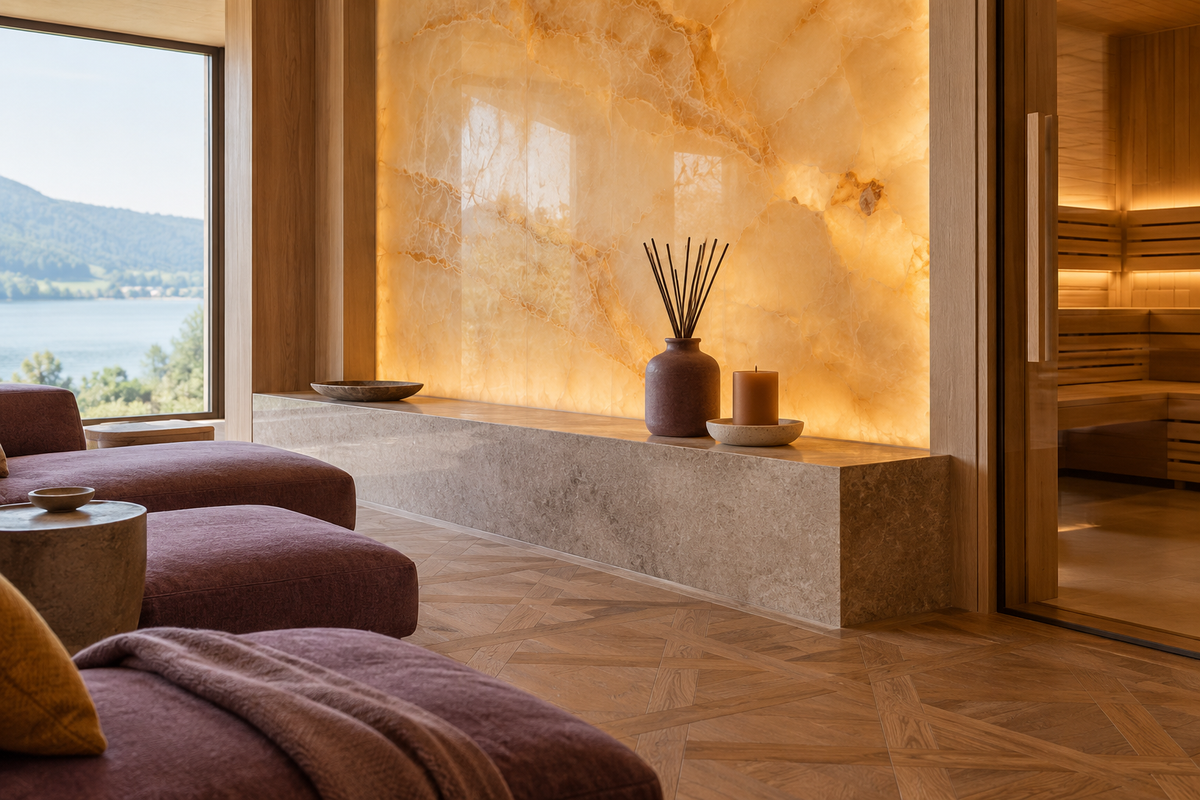
Because the slices can be translucent, it is worth choosing a place where daylight falls from the side. Backlight turns a stone slab into a glowing object.
Decorative agate objects, on the other hand, are hardly suitable for outdoor use. The mineral itself is weather-resistant, but frost in fine cracks, standing moisture at bonded joints and UV light on settings and adhesives take their toll on the object long before the stone is damaged. In addition, a considerable proportion of the agate offered for sale is dyed, especially in strong blue, pink or green. Such colours fade in direct sunlight.
Care
A soft, dry or slightly dampened cloth. No abrasive products, no coarse sponges – not because the stone is soft, but because the polish is finer than the material beneath it. On polished surfaces the shine disappears long before the stone itself suffers.
With set pieces, no water should run onto joints, bonded areas or metal parts. It dries poorly there and leaves rings. Wiping dry afterwards is usually enough.
Frequently asked questions
What is agate?
Agate is a banded variety of chalcedony, in other words a form of microcrystalline quartz. It forms in cavities in volcanic rock through the layered deposition of solutions containing silica.
Why is agate banded?
Because the silica is deposited in successive layers and each layer has a slightly different composition and colour. The bands grow inwards from the wall of the cavity.
Is agate sensitive to acid?
The stone itself barely is. Agate consists of quartz and does not react to vinegar or citric acid in the way limestone and marble do. On finished objects, however, the polish, bonded joints and settings are more sensitive than the material, so acid should not be allowed to act there either.
How is agate cleaned?
With a soft, dry or slightly damp cloth. Abrasives and rough sponges dull the polished surface.
Do two agate slices look the same?
No. Besides colour and markings, agate also differs in shape, because each slice follows the contour of its cavity.