Selenite in the Home: The Pale Stone Beyond Crystal Healing
Selenite is a crystal form of gypsum, chemically calcium sulphate with bound water. It forms where saline waters evaporate and the dissolved minerals are left behind. Because growth is slow and undisturbed, clear, fibrous or tabular crystals develop with a pale, silky sheen.
The name comes from the Greek seléne, the moon. It refers to the matt, soft lustre, which is more reminiscent of moonlight than of the hard reflection of polished stones.
In German-language sources online, almost everything written about selenite is healing-stone literature. This text treats it as what it is for an interior: a very pale, very delicate natural material that does unusual things with light.
Where the stone comes from
Gypsum deposits exist worldwide, wherever shallow seas or salt lakes have evaporated over long periods of time. For decorative-grade material, Morocco, Mexico and Spain are the most important; the United States and Italy, among others, also supply well-formed crystals.
The most spectacular specimens come from the Naica mine in Mexico. In a water-filled chamber there, selenite beams more than ten metres (32.8 ft) long were able to grow over very long periods of time, because the temperature of the solution stayed almost unchanged just above the point at which gypsum crystallises. Such conditions are rare, and they explain why size and clarity can vary so widely in this mineral.
One of the oldest documented uses also comes from Spain. The Romans quarried thinly cleavable gypsum sheets there and used them as translucent window panes, long before flat glass was available. The same effect that makes the stone interesting in the living space today was therefore the reason for using it two thousand years ago.
Not every selenite looks the same
Several forms of the same mineral are grouped under the name selenite. Tabular crystals are clear to slightly milky and can be split into thin, flexible flakes; in German this form is commonly called Marienglas. Finely fibrous pieces with a distinct silky lustre go by the name fibrous gypsum or satin spar. Crystals grown together in rosettes, which form in the sandy soils of dry regions, are called desert roses.
The trade rarely makes this distinction. What is offered as selenite is often the fibrous variety, because it is easier to work into solid forms and shows the sheen most clearly. Mineralogically this is not a mistake, since hardness, solubility and composition are the same in all forms.
The material is worked mostly by hand or with slow-running tools. Because of its low hardness it is easy to saw and sand, but it breaks just as easily along its cleavage planes. Visible fibre lines, small chips at the edges and fine clouds inside are therefore normal features of the material and not a defect.
Softer than your own fingernail
Selenite sits at 2 on the Mohs hardness scale and is in fact the reference mineral for this value. For comparison: agate is at about 6.5 to 7, travertine at 3 to 4, a fingernail at around 2.5.
This is not a side note but the most important property of the material. A fingernail scratches selenite without any effort. This is also the simplest test for telling it apart from pale marble or limestone – but not from alabaster, which in its most common form consists of the same gypsum and is just as soft.
Jewellery metals, at about 2.5 to 3, lie above this threshold. A key, a coin or a ring therefore leaves marks on a selenite surface immediately, not only after years. Anyone looking for a tray for car keys is better served by stoneware, porcelain or a hard natural stone.
Selenite makes sense as a purely decorative object for soft or stationary things: a dried twig, a flower, a folded cloth. What matters is less what lies on the surface than whether it is moved. Pushed rather than lifted, almost any object will scratch the surface.

Water is the bigger problem
Gypsum dissolves in water at around two grams per litre. In absolute terms that is little, but it is many times what dissolves from limestone, and it is precisely this difference that makes selenite delicate in everyday life.
Dissolving in the literal sense does not happen within minutes. Wiping a selenite surface with something damp once by accident does not ruin it. Damage comes from repetition and from standing moisture: drops left to dry, condensation, damp coasters. At these spots the surface becomes dull, the silky lustre disappears, and edges lose their sharpness over time.
This leads to a short rule for care: dust dry, with a soft cloth, without water, without soap, without cleaning agents. Dried-on marks can be rubbed off carefully, while abrasive sponges, abrasives and polishes are ruled out because of the low hardness. Sealants are conceivable, but they take away the matt sheen that is the stone's appeal.
In practice this means: no bathroom with a shower, no kitchen counter next to the sink, no windowsill where condensation collects in winter. A spot directly on a radiator is also unsuitable, because gypsum releases its bound water when strongly heated and turns cloudy in the process. A dry, normally heated spot in the living room or bedroom is the right one.
Why it still wins people over
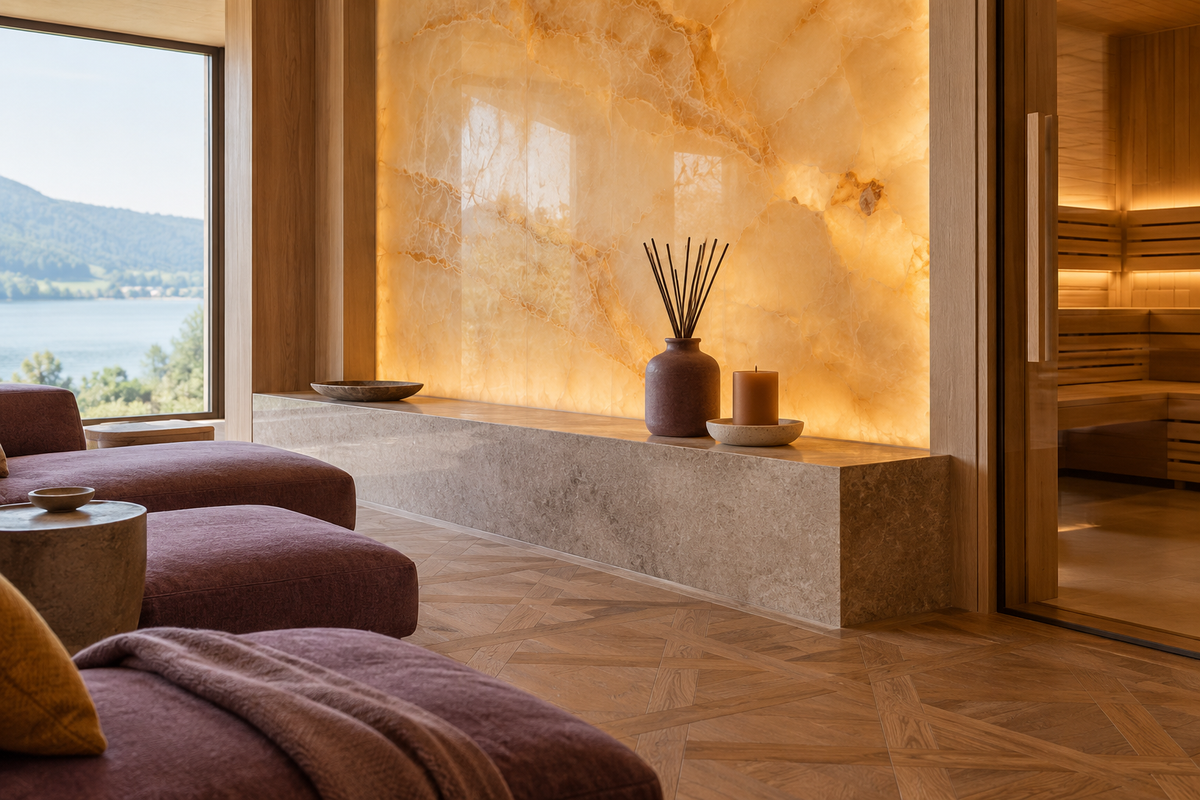
Selenite is partly translucent. In side light the stone glows from within, the fine fibre lines stand out, and the tone shifts from pure white to a warm ivory. The fibres act like bundled conductors: part of the light is passed along the structure instead of being reflected at the surface.
This effect is not unique. Thinly cut marble also lets light through, alabaster has been used for exactly that purpose for centuries, and onyx marble or frosted glass also diffuse light. The difference lies in the fibre structure, which breaks the light passing through into fine lines instead of spreading it evenly.
Then there is the colour. A pure, achromatic white quickly looks cold in a warm, earthy interior. Selenite avoids this because its white is broken by the fibre structure and appears warmer or cooler depending on how the light falls.
The crystal context
In crystal and healing-stone literature, selenite is mentioned often, usually as a stone said to cleanse or charge other stones. For many people this is the actual reason for bringing it into the home. Such an effect cannot be demonstrated; it belongs to the realm of personal conviction and not to the study of materials.
One practical note belongs here, however: if other minerals are placed on a selenite surface, the same difference in hardness applies as with keys and coins. Almost every gemstone is considerably harder than gypsum and leaves scratches. To keep the surface intact, put a soft cloth in between or set the pieces beside it.
The context does not change the assessment of the material. Soft stays soft, sensitive to water stays sensitive to water.
Frequently asked questions
What is selenite?
Selenite is a crystalline form of gypsum, that is, calcium sulphate with bound water. It forms when saline waters evaporate and develops clear, tabular or fibrous crystals with a silky lustre. Marienglas, fibrous gypsum and desert rose are forms of the same mineral.
How hard is selenite?
It has a Mohs hardness of 2, which makes it softer than a fingernail and considerably softer than marble, travertine or agate. A fingernail scratches the surface without any effort.
Can selenite get wet?
Better not. Gypsum dissolves in water at about two grams per litre and therefore considerably more easily than limestone. Brief contact destroys nothing, but standing moisture makes the surface dull and rounds off the edges. Clean it dry only.
Is a selenite bowl suitable as a tray for keys or jewellery?
No. Metals and gemstones are harder than gypsum and scratch the surface immediately. Soft or stationary objects such as dried flowers or a folded cloth are suitable.
Where is selenite best placed?
In a dry spot where daylight falls from the side, because the stone is partly translucent and then seems to glow from within. Damp rooms, sinks and radiators are unsuitable.