

Furnishing a rented flat: big impact without renovating
In a rented flat, the large surfaces are given: floor, walls, windows, kitchen. That is precisely why it is worth turning your attention to the things that can actually be changed – and these often have a stronger effect than a renovation.
Light makes the biggest difference
Most rented flats have one ceiling light per room, often the one left by the previous tenant. It determines the entire mood, and it is the first thing that can be changed without any alterations.
Several floor and table lamps change a flat more than new furniture. The reason is simple: a single light source on the ceiling produces flat, even light that makes every room look barer. If the light is instead distributed across several points at different heights – floor, side table, sideboard – zones emerge and the room gains depth.
It helps to stick to one colour temperature for the bulbs. Warm light in all the lights of a room looks calm; if warm and cold tones mix, the room feels restless before you can say why. Dimmable lights or plug-in adapters with a switch widen the scope further, without touching the wiring.
If the ceiling light sits in a place where it is not needed, the cable can be moved with a hook. Drill holes can be filled and painted over when moving out – what has been agreed in the specific case is stated in the tenancy agreement, and it is worth looking at it beforehand.
Curtains higher and wider
Curtain rods mounted in the standard way sit just above the window frame and exactly as wide as the window. Both can be changed with two drill holes.
With the rod hung closer to the ceiling and mounted considerably wider, the window looks larger and the room higher. The eye reads the edge of the curtain as the upper boundary of the window, not the frame behind it. If the fabric also reaches to just above the floor, a continuous vertical line is created that stretches the room.
For this to work, enough fabric width is needed. If the panels hang beside the window when open instead of in front of it, the daylight is fully preserved. A fabric with some weight falls more calmly than a very light one. It is the intervention with the greatest impact for the effort – and what remains are two drill holes that can be closed again when moving out.
Working with the floor, not against it
Existing floors are rarely your own choice. A yellowish laminate floor or grey tiles cannot be argued away – but they can be toned down.
Large rugs cover surface area and add texture. The colour direction is important: a rug that picks up the undertone of the floor makes it look calmer; one in a contrasting tone emphasises it. With a floor that has a yellow cast, a warm, sand-coloured rug helps more than a cold grey one.
Size is just as important. A rug that is too small makes the floor around it stand out more and the room look smaller. As a guideline, at least the front feet of the surrounding furniture should stand on the rug – then the seating group reads as a coherent area and not as a collection of individual pieces.
To go with this article


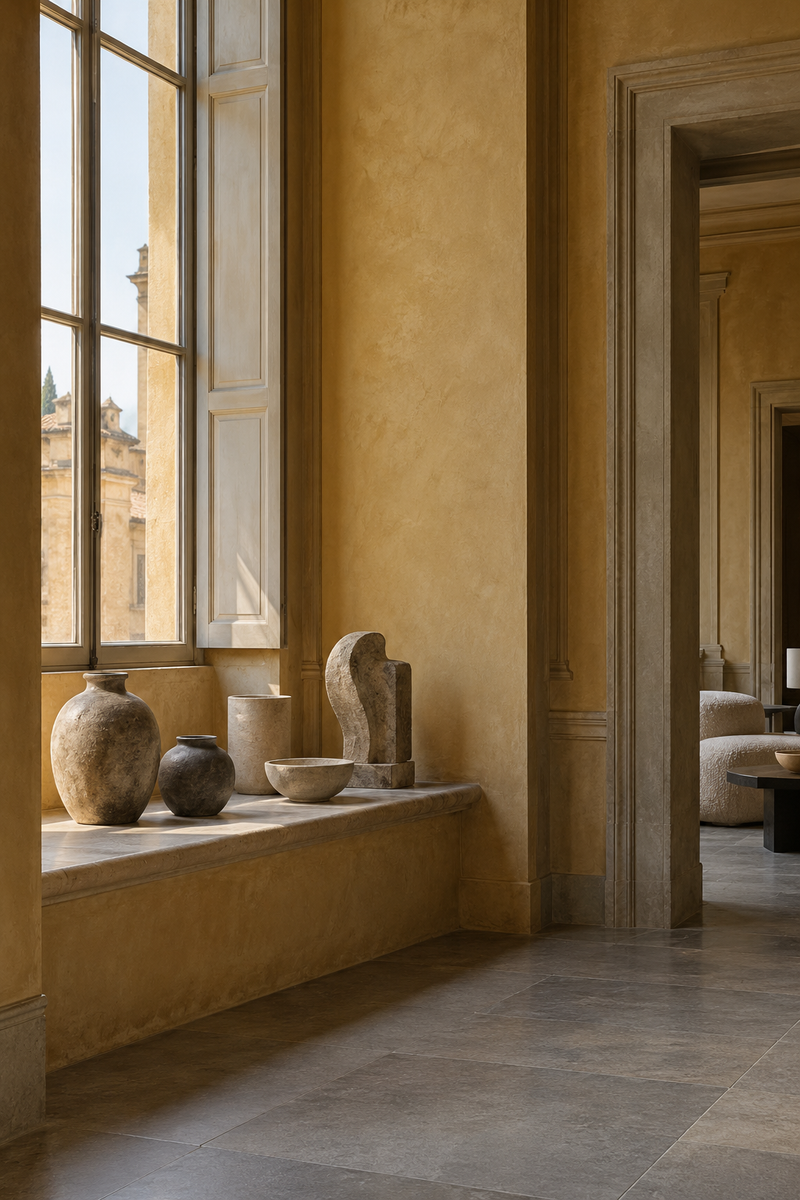
More is possible without drilling than you might think
Pictures can be leaned instead of hung – on a sideboard, a console or directly on the floor behind a piece of furniture. That looks more casual than a framed wall and can be changed at any time.
Shelves that are wedged between floor and ceiling hold a surprising amount. And free-standing coat stands or room dividers completely replace wall mounting.
For lighter things there are adhesive hooks and adhesive strips that can be removed again without leaving residue. However, they only hold on a smooth, clean and load-bearing surface; on woodchip wallpaper, open-pored plaster or freshly painted walls the result is unreliable. And for curtains in window recesses or rails in the shower there are tension fittings that hold purely by pressure between two walls.
Investing in things that move with you
The most important difference between renting and owning is not a design one, but an economic one: what is permanently installed stays behind.
That is why money is better spent on things that come with you on the next move – furniture, lights, rugs, objects. They work again in the next flat, while a painted wall or a permanently fitted shower screen stays behind in the flat.
Planning for the next move also means choosing rather restrained forms and dimensions. A piece that only suits a particular floor plan or a particular wall colour loses its place when you move. Calm tones, clear forms and dimensions that are not tailored to a single niche survive several homes.
In this way, a good piece of seating or a durable object made of stone, wood or ceramic accompanies you through several moves. That is the quiet advantage of movable furnishings.
Frequently asked questions
What changes a rented flat the most?
Light. Several floor and table lamps have a stronger effect than new furniture and can be changed without altering the flat.
How do you hang curtains in a rented flat?
Closer to the ceiling and wider than the window. Two drill holes are enough, and they can be closed again when moving out.
What can you do about an unattractive floor?
Large rugs that pick up the undertone of the floor instead of working against it. And the rug should not be too small.
What is possible without drilling?
Leaning pictures, tension shelves between floor and ceiling, free-standing coat stands and room dividers, and adhesive hooks for light things on a smooth surface.
What is worth spending money on when renting?
Movable things – furniture, lights, rugs, objects. Anything permanently installed stays behind when you move out.
View all lights in the shop
View all rugs in the shop
View all decorative objects in the shop


