


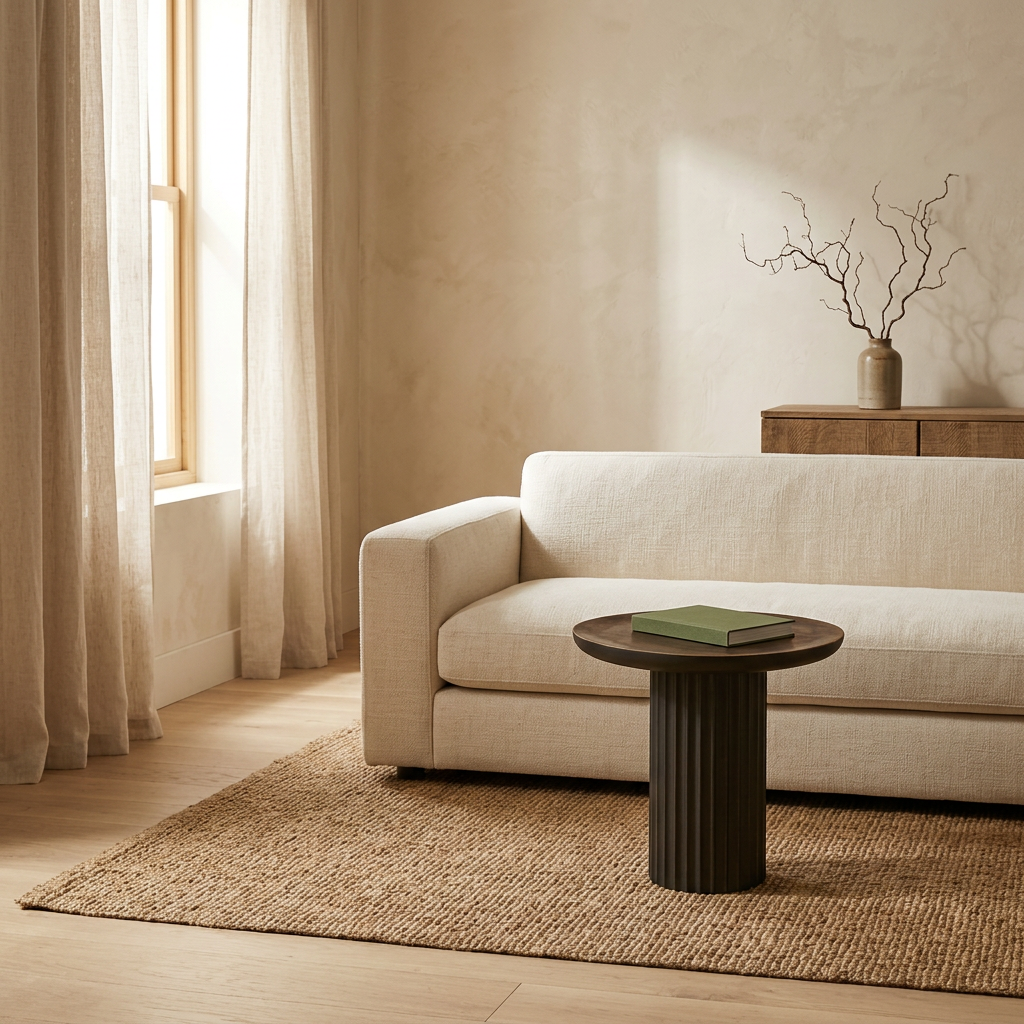

Description
Clear water stands over shallow ground. It can be seen through, but not without refraction – whatever lies beneath appears closer and sharper than it would without water.
The top of LAGO is a shallow tray with a raised rim all round, under a clear layer of resin. The grain of the mango wood runs through; the surface above it stays smooth.
Beneath stands a base of black enamelled metal, grooved vertically like the shaft of a column. One surface reflects light, the other breaks it into stripes.
On the material
Wood moves: why joints shift and boards crack
Wood is the only material in the living space that keeps moving after it has been worked. It takes up moisture from the air and releases it again, and in doing so it changes its dimensions – every year, in every heated room, with every type of wood.
Once you have understood this, you look at a piece of furniture differently. A joint that becomes wider in winter is then not a workmanship fault but proof that someone thought ahead. And a crack in a tabletop almost always has the same cause.
Related in the Journal

Rooms
How objects work together once they are in place.
All articlesFrom the Journal
Journal
- Warm Colours in the Living Room Without It Feeling HeavyWarm colours in the living room rarely fail because of the choice of colour. They fail because everything is…
- Pendant Light over the Dining Table: The Right HeightWith a pendant light above the dining table, three dimensions determine whether it works: the height above…
- Coffee Table: The Right Height and Size for the SofaA coffee table has three dimensions that determine how it looks: height, length and distance from the sofa.…
- Furnishing the dining room: what a cabinetmaker looks for in a table and chairsA dining room almost never fails because of taste. It fails because of four measurements that have to be…
- Caring for a wool rug: what wool needs and what harms itWool is one of the easiest rug fibres to care for – as long as it is treated correctly. At the same time it…
- Pairing Cognac Leather: Colours That Work with ItCognac leather is not a single colour but a range – from light caramel to deep reddish-brown. What all…
- Which Colour Goes with Walnut?Walnut is a dark wood with a warm, slightly reddish-brown undertone. It is precisely this undertone that…
- Grouping vases: height, number, spacingA single vase is an object. Three vases are either a group or a muddle. The difference lies in three…
- Choosing a rug: size, material, placementThe most common mistake when buying a rug is the size. A rug that is too small not only looks lost itself,…
- Styling sideboards and shelvesA sideboard is a surface that fills up by itself. Without a plan, after a few weeks it holds post, charging…
- Choosing a sofa: what really mattersA sofa is the most expensive and longest-lasting piece in most living rooms. And it is the one where the…
- Using natural stone decor well: bowls, vases, objectsNatural stone brings to a room what textiles and wood do not provide: mass. A stone object looks heavy even…
- Choosing an armchair: size, material, positionAn armchair is usually bought for its looks and judged by its comfort. The two are less connected than one…
- Buying Furniture Online: The Measurements Nobody Thinks OfWhen buying furniture online, the choice is rarely the problem. The problem is the route in between: the…
- How Natural Materials AgeA piece of furniture made of solid wood, leather or stone looks different after five years than on the day…
- Why a Room Feels Restless Even Though Every Piece Is BeautifulThere are rooms in which every single piece is good and yet the room as a whole never feels settled. The rug…
- Side Tables: The Right Height for Each Piece of FurnitureA side table is the piece of furniture that is measured least often and placed wrongly most often. It takes…
- Lighting the Living Space: Kelvin, Lumens and Three LevelsLight is the only furnishing decision that changes twice a day. Until the afternoon the window does the…
Origin, Material & Craft
- Natural stone: why limestone does not tolerate acidNatural stone is usually bought for its looks and regretted for its looks. Yet almost everything that…
- Wood moves: why joints shift and boards crackWood is the only material in the living space that keeps moving after it has been worked. It takes up…
- Fragrance without flame: how wax and diffusers workA home fragrance without a flame and without electricity does not sound very technical. In fact there are…
- Rug fibres: wool, jute and polypropylene comparedWith a rug, the fibre determines almost everything: how it feels, how quickly it looks dirty, whether it…
- Acrylic and PLA: where plastic is the better materialPlastic has a poor reputation in interiors, and mostly rightly so: it is used because it is cheaper. But…
- Metal in the living space: why brass tarnishes and stainless steel does notMetal is the only material in the living space where almost everything you see is only a few micrometres…
- Upholstery fabrics: what rub counts and lightfastness tell youAn upholstery fabric is the only part of a piece of furniture that is touched every day. It decides how the…
- Glass in the living space: wall thickness, colour and what harms itGlass is solidified melt. Sand, soda and lime become liquid at 1,300 to 1,600 °C, and during cooling there…
- Paper pulp: why a vessel made of paper holds waterPaper pulp, usually just called pulp in the trade, is waste paper that has been soaked, broken down into a…
- Ceramics, earthenware, porcelain: the difference in everyday useCeramics is the umbrella term. Earthenware, stoneware and porcelain are subgroups of it – distinguished not…
- Tenon, dowel, screw: what wood joints reveal about qualityFurniture rarely breaks in the middle of a part. It fails at the points where two parts come together. That…
- Oak, ash, walnut: three woods comparedOak, ash and walnut together account for most high-quality furniture. They differ in colour, hardness,…
- What a cabinetmaker checks first when buying furnitureAnyone who has done a cabinetmaking apprenticeship looks at a piece of furniture in a particular order. It…
- Solid wood, veneer or wood effect: how to tell the differenceA piece of furniture can look like wood in three different ways, and only one of them is wood all the way…
- Teak root: how a piece of root becomes a tableTeak is the wood of Tectona grandis, a broadleaf tree from the monsoon forests of South and South-East Asia.…
- Borosilicate Glass: Why There Is More to It Than Heat ResistanceBorosilicate glass is glass to which boron trioxide has been added. This ingredient fundamentally changes a…
- Cement as a Home Material: Raw, Calm, Surprisingly Easy to Care ForCement is not a material but a binder. Limestone and clay are fired together into clinker; the clinker is…
- Selenite in the Home: The Pale Stone Beyond Crystal HealingSelenite is a crystal form of gypsum, chemically calcium sulphate with bound water. It forms where saline…
- Agate: Why No Two Slices Are AlikeAgate is a variety of chalcedony and therefore a form of quartz. It forms when solutions containing silica…
- Caring for Travertine: What the Stone Needs and What Harms ItTravertine is easy to care for, as long as two properties are taken into account: it is porous, and it…
- What Is Travertine? The Stone That Makes Rooms WarmTravertine is a limestone that forms at freshwater and thermal springs. Lime-rich water comes to the…
- The Story Behind Lorenz LaurentI trained as a cabinetmaker. Not as a detour, but because I was interested in how furniture holds together.…
- Handmade, Manufactory, Series: What the Terms Mean“Handmade” appears on a great many products. There is no fixed threshold for how much handwork a piece needs…
- Materials You Can See and FeelA room looks expensive or cheap long before anyone knows a price. The difference rarely lies in the form. It…
- Country of Origin on Furniture: What It MeansThe label on a piece of furniture names a country. Sometimes it names only a region or a city. What it…
Rooms
- Furnishing the living room: a calm foundationA living room rarely becomes restless because the individual pieces do not go together. It becomes restless…
- Making small rooms feel largerSmall rooms feel cramped not because there are too few square metres but because too many edges interrupt…
- Furnishing the hallway and entranceThe hallway is the first room you enter, and usually the only one that was never planned. Yet it sets the…
- The terrace as additional living spaceMost terraces are furnished, but not arranged. Four chairs around a table, everything against the house wall…
- Open-plan living and dining: zones without wallsAn open floor plan solves one problem and creates a new one: the room is large, but it has no order. Without…
- Furnishing rooms with little daylightA room with little daylight is usually painted white. That is the obvious choice and often the wrong one –…
- Making the kitchen more homelyKitchens are planned for function and rarely looked at again afterwards. Yet in many homes the kitchen is…
- Organic modern interiors: warm, tactile, with depthOrganic modern is harder to put a label on than Scandinavian or Industrial. What is meant is less a fixed…
- Furnishing a rented flat: big impact without renovatingIn a rented flat, the large surfaces are given: floor, walls, windows, kitchen. That is precisely why it is…
- Creating a reading nookA reading nook needs little space and is nevertheless rarely used. Usually it is not the armchair that is…
- Making the bathroom more homelyA bathroom consists of tiles, glass, ceramic and metal – all hard, smooth and cool. That is precisely why it…
- Furnishing high-ceilinged rooms and period homesHigh-ceilinged rooms are what many people look for – and then find difficult to furnish. The reason is that…
- Integrating a workspace into the living roomA workspace in the living space brings two problems with it: it looks like work, and it is visible even when…
- Furnishing an attic with sloping ceilingsAttic floors have more floor area than usable space. The square metres on the plan say little about how much…
- Furnishing a small balconyA balcony is often the smallest area in the home and is nevertheless furnished like a terrace. A complete…
- Furnishing a calm bedroomA bedroom has a single task, and yet it is often treated like a second living room. Most improvements come…